
Asset Data with Long-Term Value – Engineering Surveying in Transition
How is engineering surveying changing in the age of GIS, BIM, and 3D data? How important is long-term maintenance of as-built data for complex infrastructure projects? And what does it take for an engineering service provider to remain successful in the future?
In the current BDB Engineering Bulletin 02/2026 says the managing director Thomas Nußbaum about the evolution of the surveying industry and of Hemminger—and about the issues that have shaped our work for decades: reliable data, technological advancements, long-term customer relationships, and the demands of complex large-scale projects.
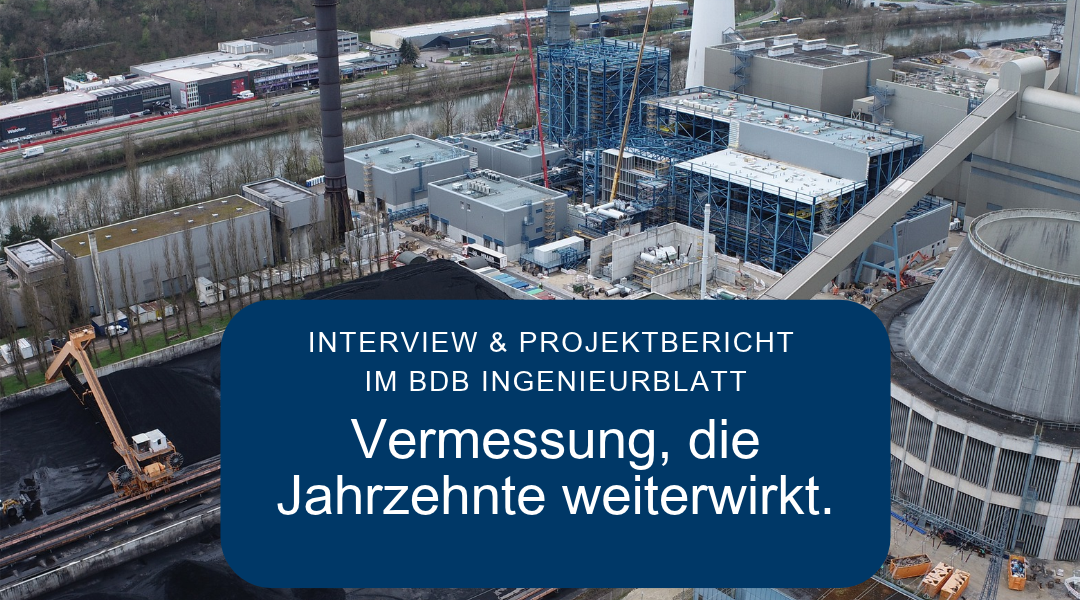
The interview is supplemented by a project report on the EnBW Altbach/Deizisau Power Plant, which clearly demonstrates the value that high-quality inventory data can still hold decades after it was collected.
From Surveying to a Digital Database
Since joining Hemminger in 1990, Thomas Nußbaum has been involved in the technological development of surveying from various perspectives—from field work to project and department management, all the way up to executive management.
Digital theodolites, GPS, mobile mapping, laser scanning, drones, GIS, and BIM have fundamentally transformed the possibilities for data collection and processing. The central task, however, has remained the same: to reliably capture the real world and generate data from it that can serve as the foundation for further processes.
For Thomas Nußbaum , it is therefore clear:
"Surveying remains the foundation."
Today, however, the scope of services extends far beyond individual measurement points. Engineering surveying, GIS, 3D as-built data, and BIM are increasingly intertwined. It is crucial to capture and process information in such a way that it becomes truly usable for planning, operations, and other project stakeholders.
When Data Gains Value Over Decades
The strategic importance of this data is illustrated by the location of the power plant Altbach/Deizisau.
Hemminger has been supporting the site since 1982 Surveying. Since then, above-ground and underground structures, as well as utility infrastructure, have been continuously surveyed and documented in a digital set of plans.
What initially served as a reliable record of the power plant inventory has, more than four decades later, become an important foundation for the site's transformation.
As part of the Fuel Switch The energy supply at the site is being restructured. Especially on a power plant site that has grown over decades and is densely built up, reliable information about existing lines, facilities, and structures is an essential prerequisite for planning new infrastructure.
The example shows: Asset data is not a short-term project outcome. If it is consistently maintained, it can become a long-term component of a company's technical infrastructure.
Data Quality as a Factor in Complex Large-Scale Projects
Operators of large industrial and infrastructure facilities, in particular, face the challenge of further developing existing structures without losing track of their current assets.
The point here is not to always record data with maximum precision. In the interview, Thomas Nußbaum emphasizes that it must be clarified before the project even begins, what level of accuracy is actually required for the specific application.
Depending on the project, various methods may be appropriate—ranging from traditional surveying to site inspections and drone imagery, all the way to mobile mapping and 3D scanning.
Ultimately, what matters is not the specific technology, but a dataset that meets the client's requirements and can be reliably reused in subsequent processes.
Experience Meets Technological Advancement
The interview also offers insights into Hemminger’s own development. What began as a traditional engineering firm has evolved into a company that today combines surveying with Geodata management, network documentation, 3D as-built documentation, BIM, and other data-related services connects.
Modern data collection methods are specifically combined for this purpose. Whether it’s traditional surveying, drone flights, or mobile mapping—the goal is to efficiently collect the information required for each specific application and make it available in a structured format for further use.
International cooperation is also playing an increasingly important role in large-scale projects. For Thomas Nußbaum , the tangible added value for the client remains the decisive factor: New technologies and structures make sense when they help to, Provide data efficiently and manage projects reliably.
Developing the Next Generation and Knowledge Transfer as a Task for the Future
In addition to technological issues, Thomas Nußbaum also discusses a second key challenge facing the engineering industry in his interview with the BDB: attracting qualified professionals and fostering their long-term development.
Hemminger has been training its own employees since 1993. In addition to surveying technicians, the company’s next generation of employees also includes geomatics specialists. This is complemented by collaboration with universities and a commitment to practical academic programs.
Because no matter how much measurement methods and data models change, complex projects will continue to require people who understand technical concepts, take on responsibility, and can reconcile the needs of the various project stakeholders.
Interview and project report in the BDB Ingenieurblatt, Issue 02/2026
The full interview with Thomas Nußbaum as well as the project report “EnBW Altbach/Deizisau Power Plant – Fuel Switch” are in the current BDB Engineering Journal 02/2026, pages 22 through 26 published.
If you'd like to learn more about how Hemminger is currently supporting the Fuel Switch project with engineering surveying during construction, you can find details on the specific surveying services in our previously published project article: → Fuel Switch Altbach/Deizisau: Engineering Surveying for the Power Plant Retrofit